


Basilica Cistern
History
-
330
Roman Emperor Constantine I, who began refounding the city in 324, inaugurated it as the new capital of the empire on 11 May 330. As there was no large river on the Historic Peninsula, the city's water was brought from afar through aqueducts from the reign of Hadrian onwards, and stored in wells and cisterns.
-
527 - 565
The Basilica Cistern was built during the reign of Justinian I by excavating to a great depth the large courtyard, surrounded by columns on four sides, of the colonnaded public building known as the Stoa Basilica. The Byzantine historian Procopius records that the cistern was made to store the abundant winter water for the summer months. Most of the 336 columns that carry its vaults are pieces brought from older buildings. Its water came from springs in today's Belgrad Forest area north of the city, most likely through the aqueduct dating from Hadrian's reign.
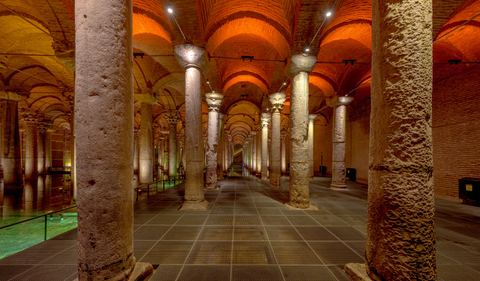
The brick vaults Walls, arches and vault are brick; walls and floor are sealed with water-resistant lime mortar. -
6th - 15th Century
After the cistern was built, the city remained the capital of the Byzantine Empire until 1453, apart from the Latin period between 1204 and 1261. Over these centuries Istanbul was shaken by major earthquakes in 557, 740, 869 and 989; the cistern was worn at times but remained standing.
-
1453
After the Conquest of Istanbul in 1453, the Basilica Cistern continued to serve the water needs of Topkapı Palace for some time. As the surrounding area gradually became populated, the cistern also emerged as a vital water source for the local community.
-
1544 - 1555
In the 16th century, the structure was “unnoticed” by Westerners until it was “rediscovered.” Between 1544 and 1555, the French naturalist and topography expert Petrus Gyllius, who lived in Istanbul, appears as the person who made this discovery. Gyllius was the first to measure the cistern’s dimensions and according to him, it was 336 feet long, 182 feet wide, and its circumference was 224 Roman steps. He also counted the columns and recorded that there were exactly 336 of them, as well as mentioning the existence of several wells on the top of the cistern. Gyllius’ statements about how people drew water with buckets, rowed boats, and used lamps for illumination inside the cistern, with air and light seeping through the wells, show that the locals were “aware” of the cistern at that time and this information has been passed down to the future.
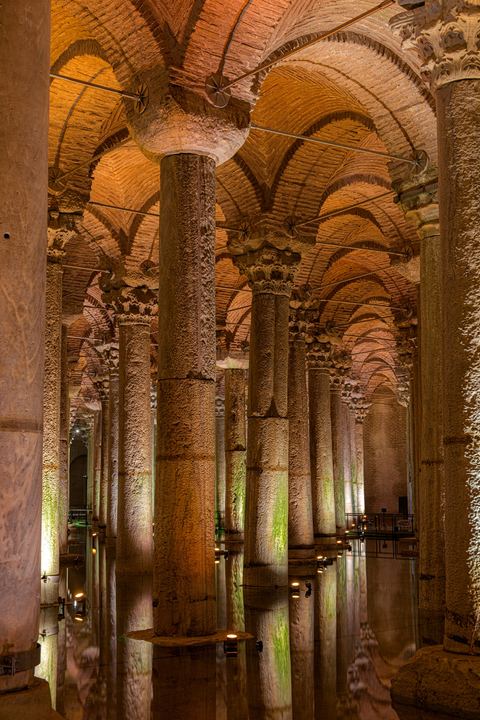
Columns in the water When full it held about eighty thousand tons of water, stored in winter for the summer months. -
1955 - 1960
In the Ottoman period, the Yerebatan Cistern underwent its first restoration during the reign of Sultan Ahmed III, and the second restoration during the reign of Sultan Abdulhamid II. In the following years, it continued to undergo various restoration efforts. Between 1955 and 1960, nine columns under the risk of collapse were covered with a thick layer of concrete to prevent further deterioration.
-
1985 - 1987
The Medusa heads, used as column bases, are positioned one upside down and the other on its side. These Medusa heads, considered one of the most exceptional examples of Roman sculpture, have attracted great attention from visitors and have become the subject of many legends.
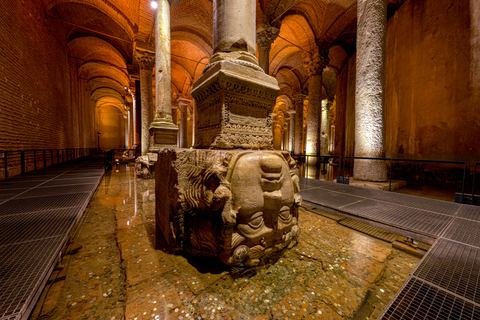
A Medusa head as a base Not a capital but the block under the column: a piece of Roman-period sculpture. -
The Present
After undergoing extensive restorations, the Basilica Cistern emerged as one of Istanbul’s premier tourist attractions. Over the years, it has hosted numerous distinguished international visitors, including Bill Clinton, Wim Kok, Lamberto Dini, Göran Persson, and Thomas Klestil. Today, it remains one of the city's most iconic cultural and historical landmarks.
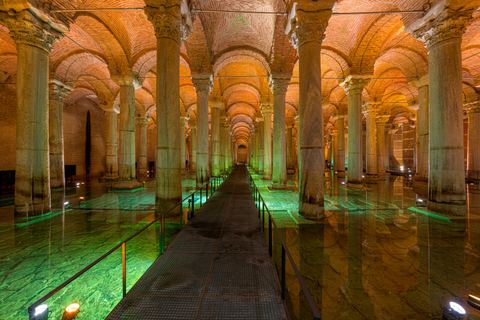
The central walkway The vault rests on 336 columns: 12 rows of 28.


Fifteen centuries on, the cistern still receives its visitors walking above the water.
Next
See the cistern for yourself